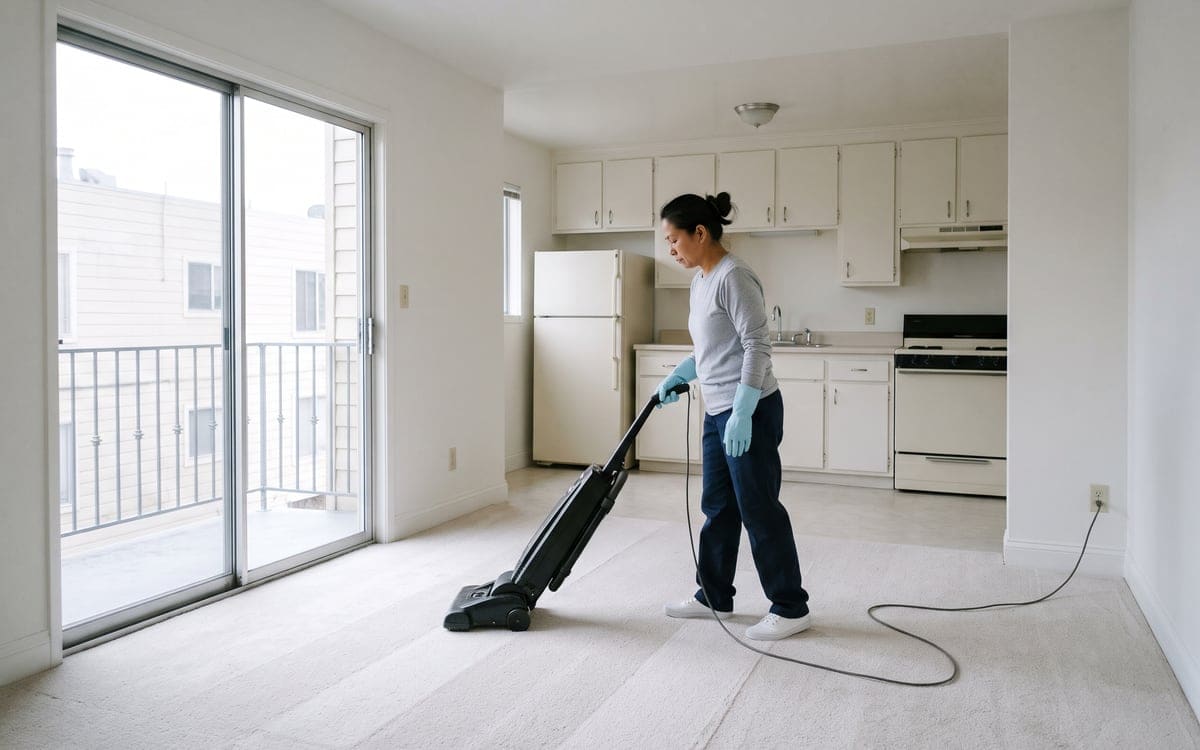
A move-out clean is a deep clean of an empty home
The scope of a move out cleaning overlaps most of a deep cleaning's list. Grout at the seams, baseboards from end to end, blinds, switch plates, door frames, the tops of cabinets dusted from the floor, and the floor of each closet. The inside of the oven and the inside of the fridge are asks on a deep cleaning and usually included on a move-out. Both visits run top down and leave the floors for last. A deep cleaning service covers the lived-in version of this list, and a move out cleaning covers the empty-apartment version.
What is different is not what gets cleaned. It is how much of each surface a cleaner can get to.
Why empty rooms reach further than a lived-in deep clean
An empty room gives a cleaner access that a lived-in home does not. The closet floor is bare, not under three shoeboxes and a laundry hamper. The drawer under the oven comes out all the way. The space behind the sofa is now floor, with the sofa gone. The inside of a kitchen cabinet opens as a surface once the pasta and the mixing bowls are packed. In those conditions, a cleaner reaches work a deep clean in a lived-in home has to work around.
The appliances still stay where they are. A refrigerator stays plugged in on its floor; a stove stays in its cutout. The reachable front edges under them, with the appliances left in place, get a wipe either way. What opens up are the cabinets, the closets, the drawers and every wall-to-wall run of baseboard the furniture used to break into pieces.
| What opens up when the home is empty | In a lived-in deep clean | In a move-out clean |
|---|---|---|
| Closet floors | Where things do not sit | Entire floor, corner to corner |
| Baseboards | Where the sofa, the bed and the dresser allow | End to end in every room |
| Kitchen cabinets, inside | Not included | Each cabinet emptied, wiped, dried |
| Dresser and nightstand drawers | Not opened | Removed when they slide clean, wiped out |
| Behind the fridge | A reachable edge | The reachable edge, since the fridge stays in place |
| Window sills and sashes | On windows the household uses | On every window the home has |
What a lived-in deep clean cannot get to
Some surfaces are hidden by belongings and some by routine. The lived-in deep clean handles the first category to the point the belongings allow. The second category, the one a household has decided to live around, often stays where it is. A spot where a plant pot has sat for two years leaves a halo on the floor that the plant is still on top of. The strip of wood behind the dresser is a few inches a cleaner cannot see with the dresser against the wall.
A deep cleaning works inside the perimeter of a household's life. A move out cleaning does the home itself. If the perimeter is not changing, the deep cleaning covers what the household uses day to day, and the halos stay where the pots and the dressers have put them.
Move out cleaning vs deep cleaning: the shift in scope at the door
The physical difference at the door of the apartment is a short list. A cleaner going into a lived-in home maps the clean around the household's layout, pets, surfaces not to touch and surfaces to go lightly on. A cleaner going into an empty home maps the clean around the rooms themselves, with no belongings in the way. The planning around pets, items to skip and products to avoid falls away once the household is out.
What stays the same is the sequence. Both visits run top down, kitchen and bathrooms first on surfaces, then dusting from high to low with high done from the floor, then floors last. Household hazardous waste belongs with the resident, who requests the City's free pickup or takes the waste to the residents' facility;1 the cleaning crew does not haul it out with the trash.
The deposit standard in San Francisco: the unit at move-in
A landlord may use a security deposit for cleaning needed to return a unit to the same level of cleanliness it had when the tenancy began.2 The standard is the unit at move-in, not a hotel room and not the home across the hall.
Which items appear on either visit depend on the home and on what the household has written in its lease; both sit in a conversation with the landlord that is between the landlord and the tenant. The clean does not settle a dispute, and the law linked above runs its own course.
The move-out cleaning checklist runs through the rooms the way a cleaner usually works them in an empty apartment. What moves the price in either visit sits in the cost guide.
Move-in cleaning as the mirror image
The visit the other way around is the move-in. An empty apartment waits for the household's things, and the clean goes in before the boxes do. The reach is the same as a move-out, since nothing is in the way. The reason tends to be different. On a move-in, the household has not been in the home yet. On a move-out, the household has been in the home and the clean picks up where it last was. The visit is the same work from a different side.
Say when the home will be empty when you call so the plan matches the keys. The move clean works at either end of the lease, since the same empty-home conditions apply to an apartment going out and one coming in.
Which one to ask for at your move
Whether the household is in the home decides most of it. A full home takes a deep cleaning. A home that will be empty when the cleaner arrives takes a move-out. The two are not substitutes; the empty home opens up what the lived-in deep clean has to work around.
Scope follows from that. A deep cleaning in a lived-in home can be scheduled for most rooms, with the kitchen and the bathrooms as the usual priorities, while a move-out clean is all rooms, since the household is leaving the home behind and the landlord is going to see the whole place.
Lease timing is the third piece. A move-out clean lands after the household's things are out. Say when the home will be empty on the call so the plan matches the keys.