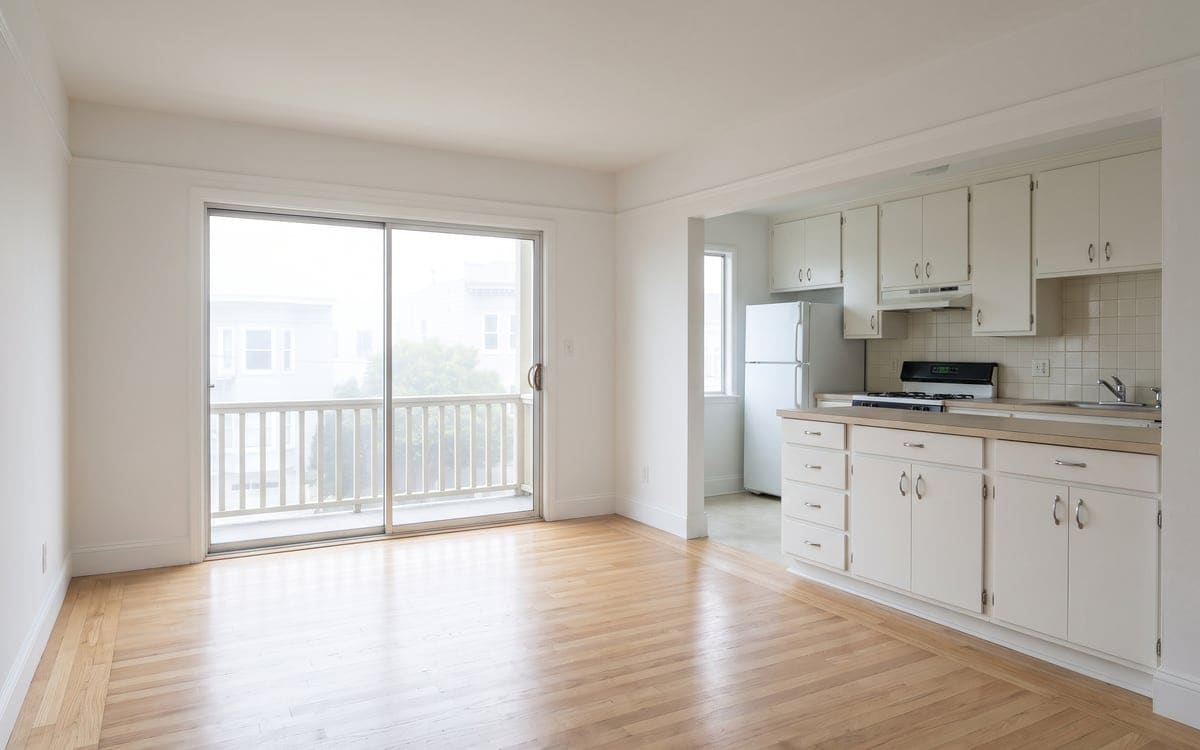
Thousands of San Francisco units sit empty between tenants
Out of San Francisco's roughly 50,632 vacant units, about 16,230 are vacant and for rent.1 Each unit that turns over calls for a cleaning that brings it back to its starting condition before the next tenant arrives.
Renters move often
Of San Francisco's 224,913 renter-occupied units, about 19,964 households moved in during 2023 or later, and another 73,993 moved in between 2020 and 2022.2 That is roughly 94,000 renter households that moved in during 2020 or later, about 42 percent of all renter-occupied units in the city. Each new tenancy resets the cleaning baseline.
| San Francisco renter data | Count |
|---|---|
| Total renter-occupied units | 224,913 |
| Renters who moved in 2020 to 2022 | 73,993 |
| Renters who moved in 2023 or later | 19,964 |
| Units vacant and for rent | 16,230 |
The move-in standard runs both ways
What California Civil Code 1950.5 allows for cleaning is cleaning necessary to return the unit to the same level of cleanliness it was in at the inception of the tenancy.3 The unit's cleanliness when the tenancy began is what any end-of-tenancy cleaning claim is measured against.
At the start of a new tenancy, California Civil Code 1941 requires that the lessor of a building intended for the occupation of human beings must, in the absence of an agreement to the contrary, put it into a condition fit for such occupation.4
Getting the unit ready to show
A unit cleaned to the move-in standard is also clean enough to photograph and show to prospective tenants.
If there has been renovation work between tenants, the dust and debris from that work are separate from what a standard turnover cleaning covers. A post-construction cleaning addresses what renovation work leaves behind; a standard turnover cleaning does not. A deep cleaning service may be appropriate for a unit that has been vacant for a longer period or that was left in heavier-than-average condition.