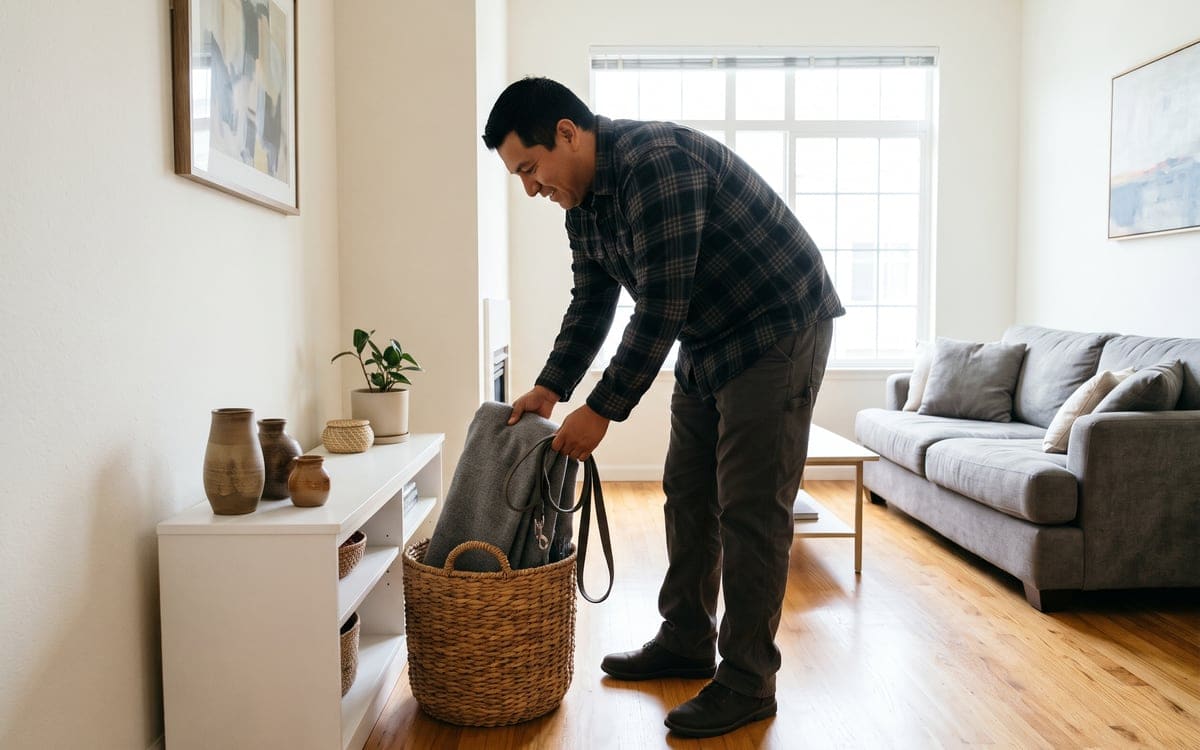
Clear what only you can put away
The surfaces that carry the most work are the ones a cleaner cannot reach because something is on them: mail stacked on the kitchen counter, a dresser top with a dozen small items, a bathroom vanity with everyone's bottles out, or a dining table that has become a desk. Clearing those horizontal surfaces before the visit is the single prep step with the biggest effect on what gets done.
The floor is less of a problem. Toys, shoes, laundry baskets and the odd pair of socks move easily, and a cleaner can get around them. Clear the counters, the vanities, the dresser tops and the dining table, and the rest sorts itself. What a cleaning includes is the longer room-by-room list of surfaces the visit covers.
A separate group of items is worth gathering before the visit. Jewelry, cash, prescription bottles and important papers belong somewhere out of the open, so nothing small gets rearranged while a dresser top is being wiped. A labeled tray for anything that has to stay out is a fair signal.
The cleaning is what we handle on the day
A common belief about preparing for a cleaning is that the home should be cleaned first. A house cleaning service does not expect a cleaned home; a sink with dishes in it and a floor with laundry on it is still a home a cleaner can walk into and do the work in. Vacuuming the morning before a visit is work the cleaner would have handled; save the energy for the surfaces that need a decision only the household can make.
What is worth doing before the visit is small and short: clear the horizontal surfaces that matter most to you, think through pets, sort out building access or the climb up to the door, and move anything irreplaceable into a drawer. The whole prep usually sits in a note the day before rather than a cleaning session the night of.
A quiet room keeps pets out of the way
Dogs and cats add complication to a visit. Between the sound of the vacuum and people they do not know in the home, a nervous animal has a chance to bolt out the front door that is opening and closing more than it usually does.
The simple fix is one closed room, with water, a bed, a litter box if that applies, and the door shut. On the call, say which room so the plan for the day does not run through it until the pet can be moved. A room with few surfaces is often a better choice than a bedroom with a dresser top and a nightstand; the plan runs smoother when the cleaner can finish and move on.
Animals that cannot sit in one room for the visit are worth saying up front, whether that is a big dog that needs the yard, a parrot that reacts to a vacuum or a reptile in a tank that must not be touched. Each is easier to work out on the call than at the door.
How keys, buzzers and front desks tend to work
How we get in is a question to answer before anyone is standing on your sidewalk. About 49 percent of the city's housing units sit in buildings of five or more units, and about 20 percent sit in buildings of 50 or more.1 A walk-up and a tower are different openings to work out ahead.
A few details come up on the call. Tell us what applies:
- Whether you will be home to open the door.
- A key left with a doorman or a neighbor.
- A lockbox or a smart lock code.
- A buzzer code or a front desk procedure the building uses.
A bigger building may have its own expectations for service visits. Reach the front desk or the manager in the week before the visit and ask what the building expects. The question is lower stakes if it is raised early. The apartment cleaning page has more on how buildings tend to run. The building sets its own expectations, and the household is the one with the direct line to them; no cleaner can promise a particular access setup from the outside.
Preparing for a house cleaning in a San Francisco walk-up
For a house that has the home upstairs, parking and the stairs are their own step. SF Planning describes the typical Sunset District house, built from the mid-1920s on, as a stucco-clad single-family house with a garage on the ground story and the living space above, packed on a 25-foot lot so the blocks look like attached row houses.2 What that means on cleaning day is that supplies go up a flight before anything begins, and come back down the same way at the end.
A few things make a walk-up smoother. Say on the call whether the entry is the garage or the sidewalk stairs, and what usually works for parking on your block. The visit is not pinned on a single spot.
Products: what to use, what to avoid
A fragrance preference, an ingredient to avoid, or a cat that reacts to a common cleaner all belong in what you say when you call, not at the door. Say what you want used and what you want avoided; the plan accounts for the request before anyone opens a bottle. If you want products you already use at home, say so; the cleaner can work with those.
Two rules travel with every visit. Nothing gets mixed in a bottle, and we do not ask any cleaner to mix anything. Bleach never meets ammonia, vinegar, another acid or another cleaner, under any circumstance. Household hazardous waste never rides out with the trash: an old product the household wants gone goes to the City's own program,3 not into the bin.
What to tell us when you call
A short set of answers helps the plan match the home.
| On the call | What to say |
|---|---|
| The home | Rooms, bathrooms with full and half separated, roughly the square footage if you know it |
| The building | Walk-up, two-unit, condo tower, Sunset house with the home above a garage |
| Access | You are home, a key, a doorman, a lockbox, a code, or the super |
| Pets | How many, which rooms they stay in, anything to work around |
| Products | Anything to use or avoid, scent preferences, surfaces to go lightly on |
| Rooms that matter most | What you want handled first |
| Anything particular | A sentimental item, a mirror with a damaged corner, a bowl of change by the door that stays as is |
Items on the "do not touch" list are easier to flag before a shelf has been dusted around than to recover from after a mistake. If anything has shifted since the last visit, say so on the call.
For a one-off before guests or a thorough first clean, a one-time cleaning or a deep clean sets its own scope. For a routine that keeps the home in the state the first visit sets, a recurring maid service is the longer page. More on checking out any cleaner is in questions to ask any cleaner.